Managed accounts: how to check a fund manager before you hand over your capital
Investing · · 7 min
You check a manager by what you can verify yourself: the full history of closed trades including the losing ones, the maximum drawdown, where the money sits and how you get it out. Guaranteed returns, rewards for bringing in friends and pressure to decide today give away a Ponzi scheme.
By Viktor Skrin

The eight checks at a glance
| What to check | A normal answer | A warning sign |
|---|---|---|
| Trade history | every closed trade with entry, exit and date, losing ones included | screenshots of winners, "results on request" |
| Drawdown | the maximum drawdown is stated, with when it happened | "we never have losing periods" |
| Monthly returns | a month-by-month record with some negative months | the same gain every month |
| Where the money sits | it is clear which account holds it and who controls it | "send it to the manager's card" |
| Withdrawals | the process and timing are described, requests have a history | "withdrawals only at the end of the term", "pay the tax to withdraw" |
| Source of income | market trading, the trades are visible | income from recruiting new members |
| Promises | the risk is stated plainly | "guaranteed income", "no risk" |
| Who is behind it | a known name and a direct contact | an anonymous chat and managers without surnames |
What is a managed account, and how is it different from copy trading and PAMM?
A managed account means you hand money to a manager who decides which trades to open. You receive reports and the result minus the manager's fee.
Copy trading keeps the money in your own exchange account, and the chosen trader's trades are mirrored on it automatically. You can stop copying at any moment.
A PAMM account is a pooled account at a broker: several investors fund it and one trader trades the whole pool. Results are split by share.
In all three the question is the same: can you check how this person trades before you give them money?
1. Ask for the full history of closed trades
Any trader can show ten good trades. The question is how many came in between. Ask for the complete record in a row, with no gaps, and check three things:
- whether there are losing trades: over a long stretch everyone has them, and a 100% win rate means cherry-picking or fiction;
- whether dates and prices match the chart: the entry price must sit inside that day's candle;
- whether leverage and holding time are shown: without them you cannot tell how much risk produced the result.
2. Find the maximum drawdown
Maximum drawdown is the deepest fall of the account from a peak to the following low. Example: an account grew from $10,000 to $14,000, then dropped to $10,500 and recovered. The drawdown is (14,000 − 10,500) / 14,000 = 25%. Even with an overall gain, at one point the investor was down a quarter from the peak.
Compare drawdown with return: a 30% yearly result with a 60% drawdown means the manager earns by risking too much. And ask when the drawdown happened: a deep loss in a calm month is more worrying than one during a market-wide crash.
3. Look at monthly returns, not the best period
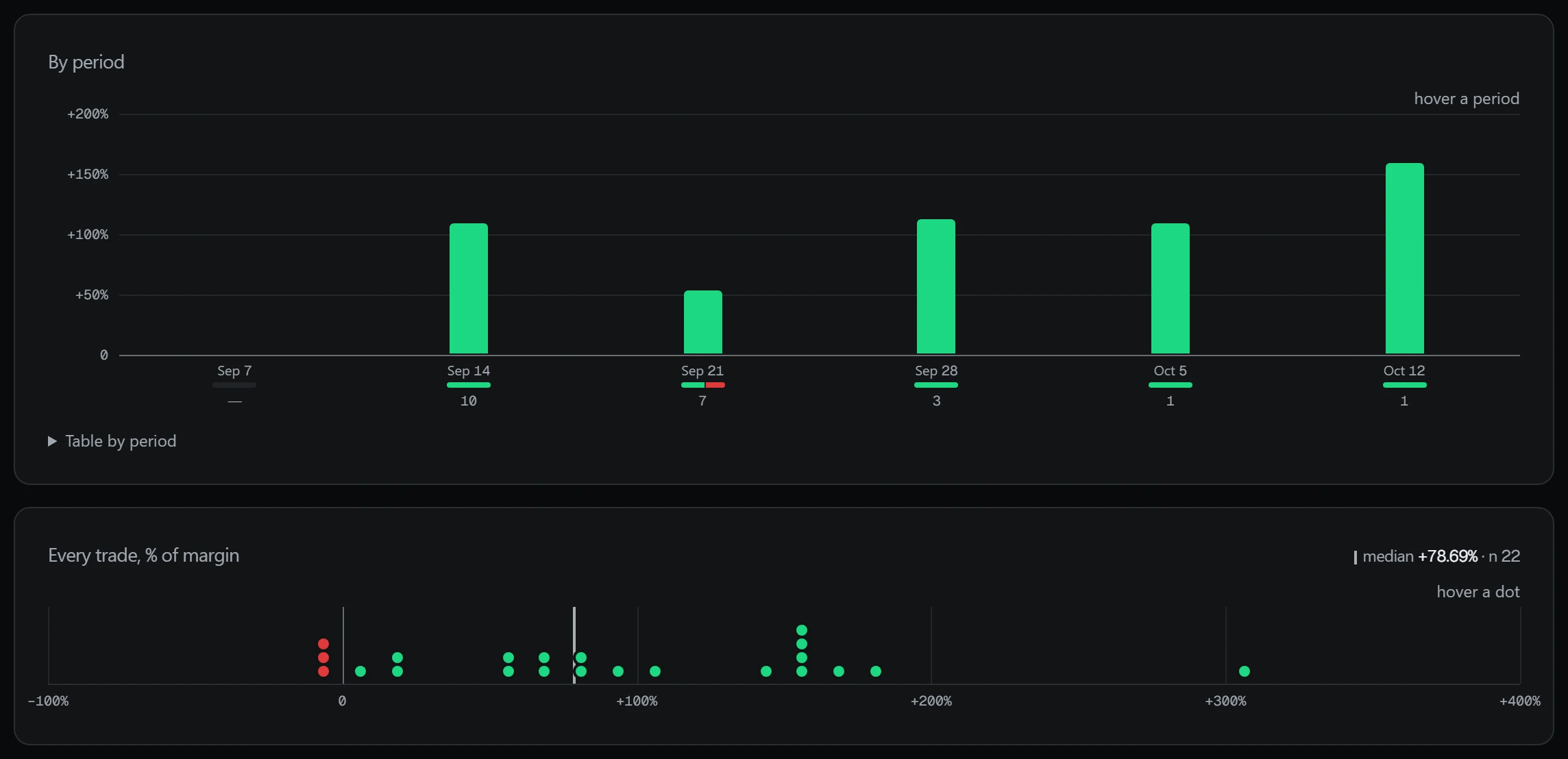
"+180% in a year" may have come from two months followed by half a year of losses. A month-by-month table shows how even the results are and what the manager does after a bad month: cut risk or try to win it back with bigger positions.
The same gain every month is the clearest sign of invented reporting. Markets do not pay like that.
4. Find out where the money sits and who can withdraw it
There are two models.
- The money stays in your account. You open an account at an exchange or broker, and the manager gets trading access without withdrawal rights. You keep maximum control, but not every manager works this way: running one strategy across dozens of separate accounts is hard.
- The money is transferred to the manager. You send the funds and the manager runs a pooled portfolio. Here the protection is verifiability: reporting on your share, a history of operations, working withdrawals and clear terms.
Neither model makes investing risk-free; they differ in what the trust rests on. It is a bad sign when you are asked to pay into an employee's personal card or into a wallet that changes from one time to the next.
5. Test a withdrawal with a small amount
The most reliable test is to withdraw part of the money a month after depositing. Find out beforehand how a request is filed, how long it takes, and whether there is a fee or a minimum.
If you are asked to "pay the tax", "insurance" or an "unlock fee" before withdrawing, it is almost certainly fraud: any legitimate fee would be deducted from the amount withdrawn, not paid with new money.
6. Work out where the income comes from: the signs of a Ponzi scheme
These things give a Ponzi scheme away:
- income is guaranteed and does not depend on the market;
- you are paid for recruiting members, with levels, "teams" and bonuses for your downline;
- you cannot tell what exactly the money is made on;
- you are rushed: "offer ends today", "three places left";
- the main argument is payouts to earlier members rather than trades.
Financial regulators in many countries publish warning lists of unauthorised firms, such as the FCA warning list in the UK; check the company name and website address there.
7. Ask about the licence and the agreement
Rules for managing other people's money depend on the country: some require a licence, others only a contract. Find out whether there is a licence and in which jurisdiction, and what the terms say about fees, withdrawal times and liability. If there is no licence, your protection is the terms, a verifiable history and working withdrawals. Understand that before you send money, not after.
8. Talk to the person who trades
Ask questions that cannot be answered from a script: why was the last losing trade closed, how is position size chosen, what happens to the account if the market drops 30%. Someone who runs the trades personally answers concretely and names their own mistakes.
How it works at Sufics
Sufics is a managed-capital service across five markets, from gold and oil to crypto. You can check it before opening an account: the closed-trade feed on the home page runs in order with the losing trades left in, and each trade has its own page with entry and exit prices, leverage, holding time and a chart. Trades come from the Binance API rather than being typed in by hand.
Sufics uses the second model: the client transfers funds, the manager runs the portfolio, and the client sees every trade, accrual and account operation in the dashboard. Withdrawals are requested in the dashboard: the amount is held until the transfer is made, and the available balance is always visible. An account is opened after a conversation with the manager on Telegram.
Trading in financial markets carries the risk of losing part or all of your money. Past returns do not guarantee future ones.
Key takeaways
- Check what you can verify: the full trade history, maximum drawdown, monthly results and withdrawals.
- Losing trades and negative months in a report are normal; their absence is the warning sign.
- Guaranteed income, paying for recruits and rushing you are signs of a Ponzi scheme.
- Test a withdrawal with a small amount before depositing a large one.
- Know what protects you: an account in your name, a licence, a contract or verifiable results.
Frequently asked questions
What return is normal for a managed account?
There is no normal guaranteed return. Look at return against maximum drawdown and at the monthly record: real results are uneven, with losing months. A promise of a fixed percent per month is a Ponzi sign, however modest the number.
How is a managed account different from copy trading?
In a managed account the money goes to the manager, who trades it. In copy trading the money stays in your exchange account, the trader's trades are mirrored on it automatically, and you can stop copying at any time.
How can I tell an investment company is a scam?
The main signs are guaranteed income, rewards for recruiting, deadline pressure, an unclear source of profit and trouble withdrawing, especially requests to pay an unlock fee. Check the name against your financial regulator's warning list.
What should I do if they will not let me withdraw?
Do not send any more money under any pretext, keep the messages, receipts and wallet addresses, file a written withdrawal request and report it to the police or the financial regulator. Services that promise to recover your money for an upfront fee are often a second wave of the same scam.