Desk theses: where several signals line up
Platform ·
Every 4 hours the screener scans the whole crypto market and flags coins where two or more signals agree. After 7 days each thesis is scored against the price.
The Momentum & funding tab has a new Desk theses block. It runs on four radars: a breakout to a yearly extreme (price within 3% of the one-year high or low), relative strength (the top 15 risers or fallers over 30 days), a funding squeeze (funding crowded against the price move) and open interest flow (hot OI turnover with new positions and a move of 3% or more in a day).
The radars use the same numbers as the tables on the page, so any thesis can be checked by eye. The breakout radar counts only coins older than 90 days: otherwise the “yearly” high would be the high of a few weeks. For a long, the funding squeeze needs a funding z of −2 or lower while the price rises over the day; for a short, +2 or higher while it falls. Open interest flow counts as hot when it has turned over three times a day or more.
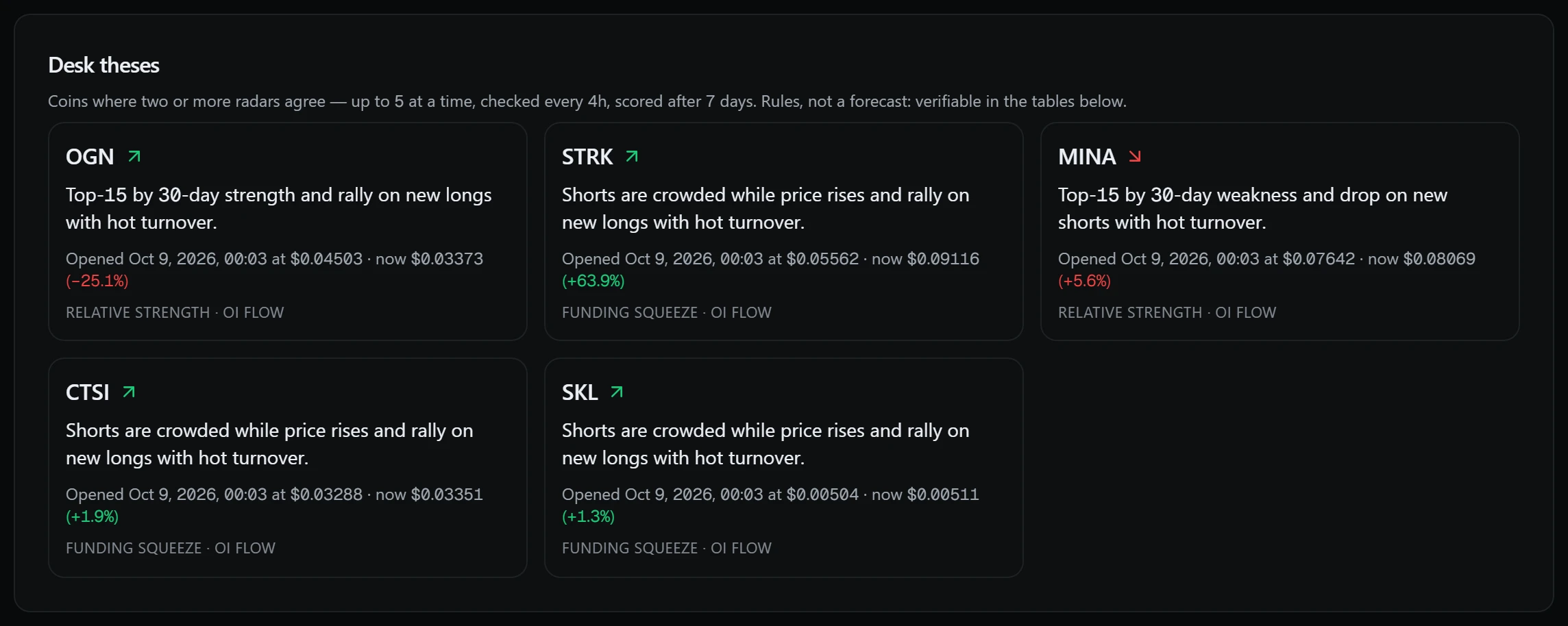
A thesis appears when two or more radars point the same way and none point against. At most five theses are open at once, one per coin, and coins on the Avoid list are left out. The market scan runs every 4 hours; each card shows the price when the thesis appeared, the current price and the radars that fired.
Only crypto contracts with at least $10M of daily turnover are considered; coins on the Avoid list are excluded however many radars agree. When there are more candidates than free slots, theses with more radars come first, and on a tie the more liquid coin does. If candles or open interest are loaded for fewer than 90% of symbols, the run is skipped so that theses are not opened on half of the market.
On the card of an open thesis the price change is coloured by the thesis direction: for a short, a falling price shows as a gain and a rising one as a loss. A click on the coin name opens its TradingView chart. When no coin has two radars, the block says there are no theses right now instead of picking weaker coins.
After 7 days a thesis is closed at the price of the hourly candle at that point, and the result goes into the Earlier theses journal. The journal is never edited after the fact; it shows the share of theses that ended in profit and the average result. The first five theses opened on 9 October and scored on 16 October. These are rules, not a forecast or a trade signal: the journal exists precisely to check them against what happened.
A thesis result is the price change of the coin in the thesis direction over 7 days: a rise for a long, a fall for a short. It is computed from entry and exit prices and excludes leverage, fees and funding. The journal shows the last 40 closed theses, a chart of results and a table with the entry, the price after 7 days and the radars that fired. The theses are visible with full access; without activation the section opens in preview mode with none.
The journal's sample is small by design: at most five theses are open, and each lives for seven days. Such a sample says little about how the rules will behave later. Desk theses are a set of rules over Binance data, not a trading system and not advice to enter a trade; any outcome involves the risk of losing money, and the section is not investment advice.