Trump posts: impact assessment and market reaction
Platform ·
Donald Trump's new Truth Social posts with a language model's view of which assets a post could move and which way, next to what bitcoin, ether, gold, oil and the S&P 500 actually did.
The Market section has a new Trump posts tab. Posts from Truth Social are collected every 5 minutes. Each comes with a short summary in Russian and English, a link to the original and an impact rating: high, medium, low or none. For the assets a post could affect, the model gives a direction, a strength from 1 to 3 and a one-sentence reason.
Posts come not straight from Truth Social but from an archive CNN maintains, since the site is closed to automated requests. The archive updates roughly every five minutes, and the platform checks it for new posts at the same interval. The link on each post leads to the original on Truth Social.
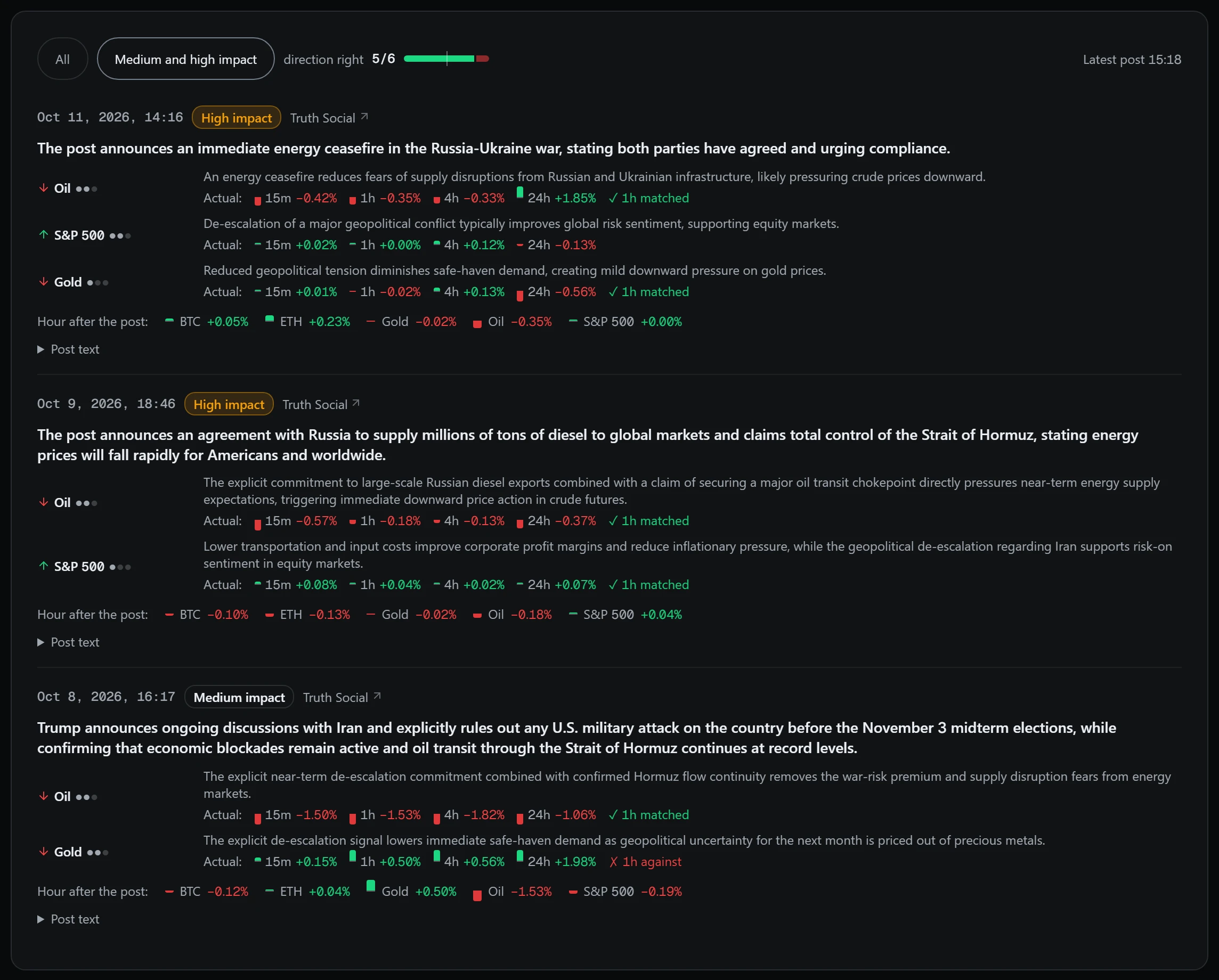
An assessment consists of a short summary, an impact rating and a list of assets. For each asset it gives an arrow up or down, a strength of one, two or three dots (1 means within ordinary noise, 3 a large move) and a reason. The model names only assets the post affects through a concrete channel. By its instructions, repeats of earlier positions that the market already prices get No impact. The Russian page shows summaries and reasons in Russian, the others in English.
The assessment is only half of it. For every post the platform itself measures what bitcoin, ether, gold, oil and the S&P 500 did after 15 minutes, an hour, 4 hours and a day. Each call shows whether its direction matched the first hour's move, and the top of the page shows the share of directions called right on that page. It tells you how far the assessments deserve trust at all.
The actual move is measured on five-minute candles of Binance perpetual contracts for bitcoin, ether, gold, WTI crude and the S&P 500. The price is compared with the price at the moment of the post; until a horizon arrives the value stays empty rather than zero. The main horizon is one hour. The bars next to each asset show the one-hour move on a shared scale for the page, so posts are comparable.
The matched mark appears when the direction of the call agrees with the sign of the one-hour move; a move that rounds to 0.00% on screen counts for neither side. The share of directions called right at the top appears once the page has at least three checkable calls, and it covers only that page's posts, not the whole history.
The Medium and high impact filter keeps only the posts the model considers significant for the market. Consecutive reposts and attachments without text collapse into a single row so they don't push the posts with content down. The assessment is the model's opinion, not a trading signal: a move after a post can be a coincidence.
The assessment is written by a language model running on a separate computer, not on the website's server. If that computer is off, a post appears marked awaiting assessment, and the line above the feed shows how many posts are waiting for the model; the assessment is added later. A post the model fails three times to answer in the required form stays unassessed. Reposts and attachments without text are not assessed.
The tab opens as a module: if it is not enabled for you, the page does not exist. Without full access the page is blurred and shows the first three posts. With full access the page holds up to 40 posts, the filter, and the Earlier and Latest links. The section is neutral: it summarises posts and shows prices without judging politics. It is not investment advice; trading carries a risk of losing money.