Leverage in trading explained: how it works and when the exchange liquidates you
Learning to trade · · 6 min
Leverage means trading a position larger than your collateral. At 10x, 100 USDT of collateral opens a 1,000 USDT position, and a 1% price move changes the collateral by 10% either way. When the loss eats through the collateral, the exchange closes the position by force: that is a liquidation. At 10x it is roughly a 10% move against you, at 50x about 2%.
By Viktor Skrin

Leverage and the distance to liquidation
| Leverage | Position on 100 USDT of collateral | Move against you to liquidation, approx. |
|---|---|---|
| 2x | 200 USDT | 50% |
| 3x | 300 USDT | 33% |
| 5x | 500 USDT | 20% |
| 10x | 1,000 USDT | 10% |
| 20x | 2,000 USDT | 5% |
| 50x | 5,000 USDT | 2% |
| 100x | 10,000 USDT | 1% |
Figures for isolated margin, ignoring maintenance margin and fees. With them, liquidation comes a little sooner.
How leverage works, by example
Bitcoin is at 60,000 USDT and you open a 1,000 USDT long on a futures contract (a bet on the price rising) at 10x. The exchange locks 100 USDT of your collateral, also called margin, which is where the name margin trading comes from. The price rises 3%: the position is worth 1,030 USDT, a 30 USDT profit, which is 30% of the collateral. The price falls 3%: the same 30 USDT loss, minus 30% of the collateral.
How much you make or lose per percent of movement is set by position size, not by leverage. Leverage only changes how much of your own money the exchange holds as collateral for that position.
What is liquidation, and how is its price calculated?
A liquidation is the exchange closing your position by force because the collateral can no longer support it. The exchange does not require the whole collateral to stay intact, only a minimum part of it, the maintenance margin. For major coins on small positions it is a fraction of a percent of position size.
For isolated margin you can estimate the liquidation price of a long like this:
Liquidation price ≈ entry price × (1 − 1 / leverage + maintenance margin rate)
For a short, a bet on the price falling, the signs flip: entry price × (1 + 1 / leverage − maintenance margin rate).
Example: a long from 60,000 at 10x with a 0.4% maintenance rate gives 60,000 × (1 − 0.1 + 0.004) ≈ 54,240. Liquidation comes after a 9.6% drop, not 10%. The exchange shows the exact price on the position card and calculates it from the mark price rather than the last trade; Binance's full formula is in its help centre. The estimate above is for sizing up liquidation before you enter.
Isolated or cross margin?
Isolated margin gives each position its own collateral. If the position is liquidated, you lose only that collateral and the rest of the balance is untouched.
Cross margin backs all positions with the whole futures balance. Liquidation moves further away because free funds absorb the loss, but if it does come you can lose far more, up to the whole account.
Isolated margin is simpler for beginners: the maximum loss on a trade is known in advance. Cross margin is used with several positions at once, when risk is controlled with stops and position size rather than leverage.
Risk management: the stop-loss and position size matter more than leverage
Risk per trade is the amount you lose if the stop-loss is hit:
Risk = position size × distance to the stop
A 1,000 USDT position with a stop 2% from entry risks 20 USDT at 5x and at 20x alike. Only the collateral (200 or 50 USDT) and the liquidation point differ. One rule follows: the stop must trigger before the liquidation. At 50x liquidation sits about 2% from entry, so a 3% stop never gets the chance.
Work it out in reverse:
- Decide what percent of the account you can lose on one trade; 1–2% is common.
- Place the stop where the trade idea stops working on the chart.
- Get the position size: risk in money / distance to the stop.
- Pick leverage that puts liquidation well beyond the stop.
Example: a 5,000 USDT account, 1% risk is 50 USDT, a stop 2.5% from entry. Position size is 50 / 0.025 = 2,000 USDT. At 5x the collateral is 400 USDT and liquidation is about 20% from entry, far beyond the stop.
How liquidations move the market
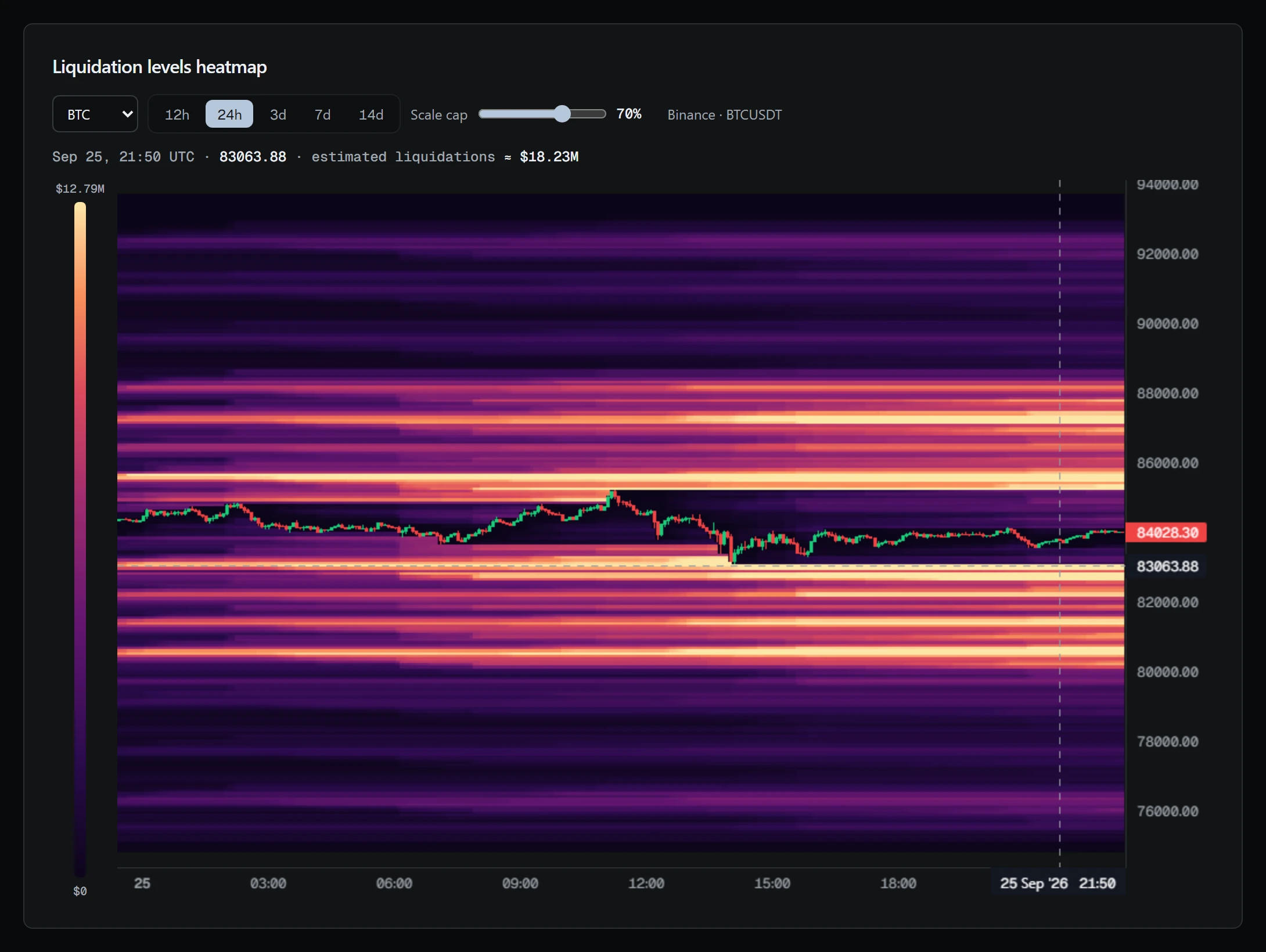
A liquidation executes as a market order. When the price falls, longs closed by the exchange are sold at market and push the price lower, into the next liquidations. That is how cascades happen: candles of several percent in minutes. With shorts it works the same way, only upward.
That is why traders watch where leveraged positions have piled up. The Sufics Liquidations section collects forced closures from Binance, Bybit, OKX and Gate and maps the price levels where, by estimate, the most liquidations sit.
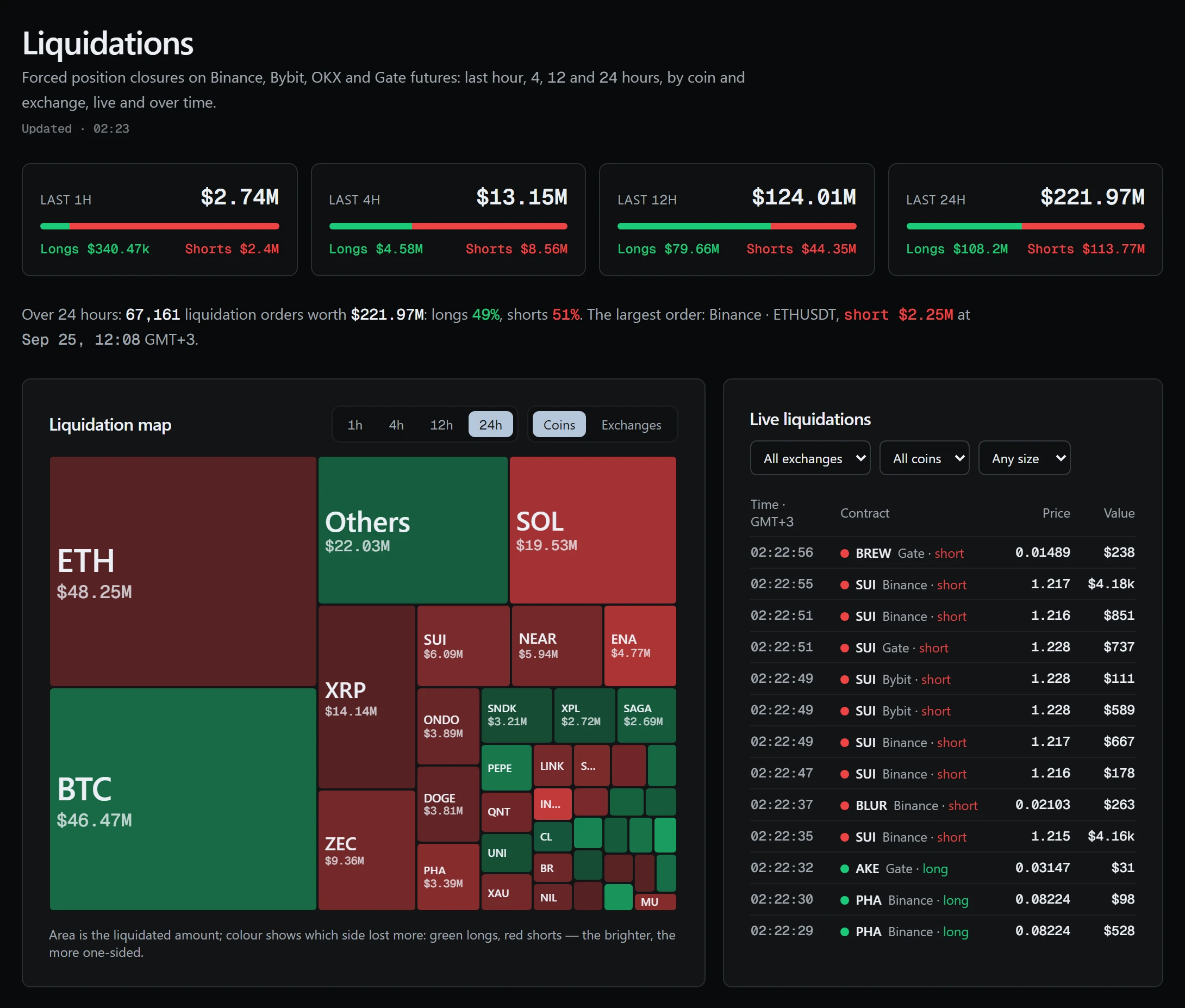
The live summary is on the crypto liquidations page; more about the section in the launch announcement.
Funding: the fee for holding a leveraged position
Perpetual futures have no expiry date, and funding, a regular payment between longs and shorts, keeps their price tied to spot. It is usually charged every 8 hours, more often on some contracts. With positive funding longs pay shorts; with negative funding it is the other way round.
At high leverage funding eats into collateral noticeably: 0.03% per period is about 0.09% of the position a day, which at 10x is almost 1% of the collateral a day.
How leverage shows in Sufics trades
Every position in the Sufics closed-trade feed lists its leverage. A trade's page shows the entry, exit, holding time and a chart with executions, so you can check the trade's prices against the exchange candles. Position size is not shown there, and the result percentage is the price move multiplied by the leverage: at ×50, a 1% move reads as 50%. See the closed trades.
Leveraged trading can cost you the whole collateral. This article is not investment advice.
Key takeaways
- Leverage of N means a position N times your collateral; liquidation is roughly 100/N percent away.
- The real liquidation price is a little closer: the exchange keeps maintenance margin and charges fees.
- Position size and the stop set the risk; leverage only changes collateral and where liquidation sits.
- The stop must come before liquidation; if it does not fit, lower the leverage.
- Isolated margin caps the loss at the position's collateral; cross margin puts the whole account at stake.
Frequently asked questions
What does 10x leverage mean?
A position ten times your collateral: 100 USDT opens a 1,000 USDT trade. Every percent of price movement changes the collateral by 10%, and a move of about 10% against the position gets it liquidated.
What leverage should a beginner use?
Leverage is chosen last: first the risk per trade (1–2% of the account), then the stop, then position size. Beginners usually do fine with 2x–5x: liquidation then sits far beyond any sensible stop, and a calculation mistake does not wipe out the collateral in minutes.
Can I lose more than my account balance?
On major crypto exchanges the loss is usually capped at the futures balance: if a position is closed worse than its bankruptcy price, the exchange's insurance fund covers the gap. With isolated margin you lose the position's collateral, with cross margin up to the whole balance.
What is the difference between a long and a short?
A long profits when the price rises, a short when it falls. With leverage both get liquidated the same way, the long on a drop and the short on a rally.
What is a margin call?
A warning from the exchange that little collateral is left and the position is getting close to liquidation. You answer it by adding margin or cutting the position, but it is better not to get there: a margin call usually means the stop is missing or sits beyond the liquidation price.