Where to invest money in 2026: five asset classes, their returns and their risks
Investing · · 6 min
There is no single answer to where to invest money: it depends on your horizon, the amount and how deep a drop you can sit through without selling at the bottom. For money you will not need for at least three years, people usually look at five asset classes: gold, stocks and indices, oil, bitcoin and ether. Below is what drives each of them, how far each has fallen in the past and how to combine them in one portfolio.
By Viktor Skrin
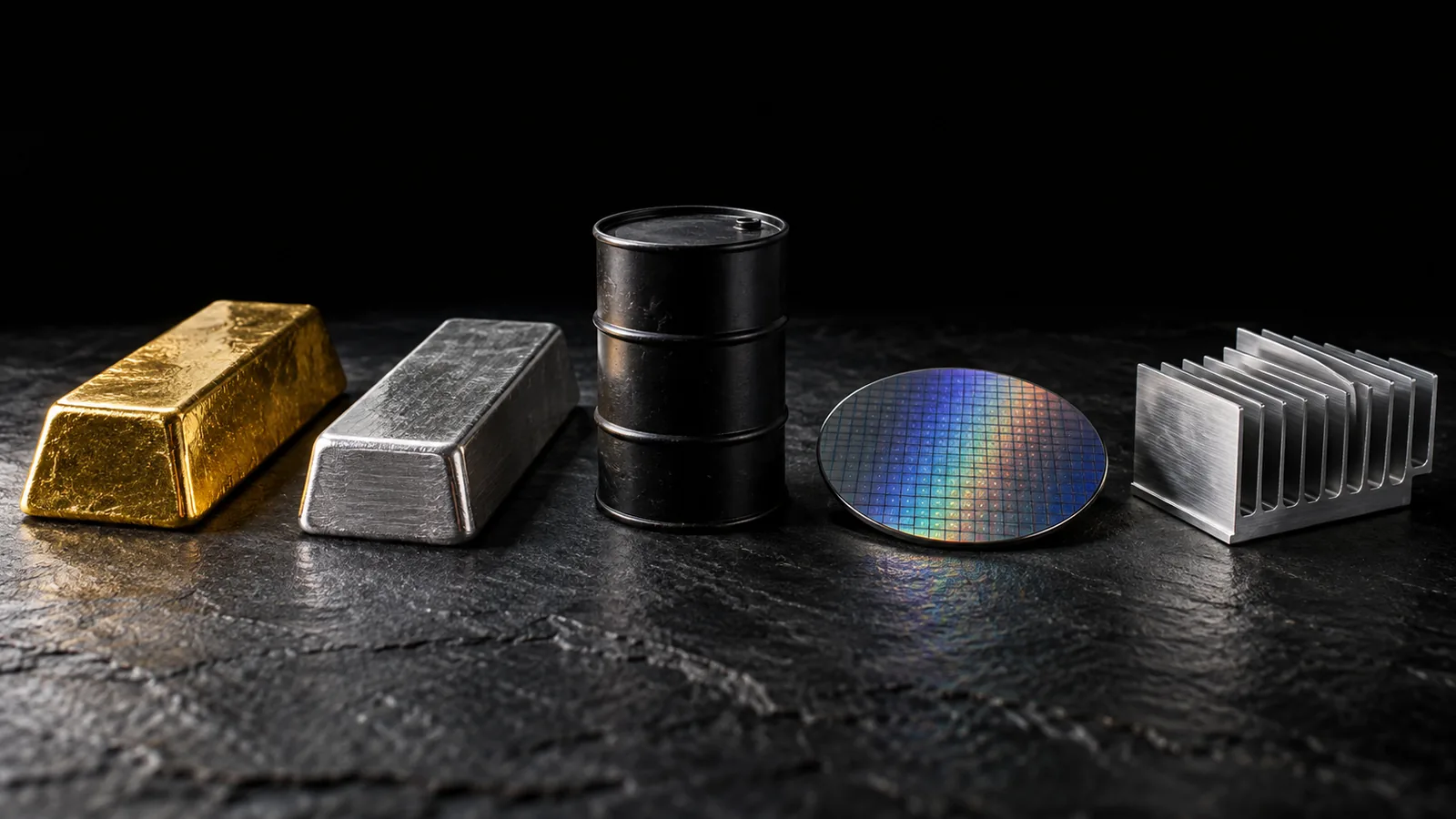
The five assets at a glance
| Asset | What drives it | Worst historical drops | Role in a portfolio |
|---|---|---|---|
| Gold | safe-haven demand, central bank buying, falling real rates | −45% (2011–2015) | the defensive part |
| Stocks and indices | company earnings and dividends | −57% for the S&P 500 (2007–2009), −34% (2020) | the core for years |
| Oil | supply and demand, OPEC+ decisions, geopolitics | about −75% for Brent (2008), WTI futures below zero (April 2020) | tactical trades |
| Bitcoin | capped supply, institutional inflows | −84% (2017–2018), −77% (2021–2022) | a risky slice |
| Ether | demand for the Ethereum network and its apps | −94% (2018), about −80% (2021–2022) | an even smaller risky slice |
The drops are measured peak to trough on daily prices. Use them to try on each asset's worst case before you buy it; nobody can tell you when the next one comes.
How do you choose where to invest?
Answer three questions before you pick an asset.
- When will you need the money? Money for the next year does not belong in the market: over a single year any of the five assets can end up in the red. Deposits or short-term bonds fit it better.
- How much loss can you watch? Count it in money, not percent: 30% of 100,000 is 30,000. If that number makes you want to sell everything, the risky part of the portfolio is too large.
- Do you have a cushion? Keep three to six months of expenses aside so you never sell assets in a drop to pay the bills.
Only then does it make sense to choose what to invest in.
Gold: a hedge against inflation and crises
Gold pays no dividends or coupons; demand moves its price. People buy it as protection against inflation and crises, and in recent years central banks have joined them: according to the World Gold Council they bought more than 1,000 tonnes a year in 2022–2024. When real rates (bond yields minus inflation) fall, holding gold costs less and its price usually rises.
In crises gold tends to fall less than stocks and recover faster, but not always: from 2011 to 2015 it lost 45% and took years to come back. So gold is held as the defensive part of a portfolio, and the growth has to come from elsewhere.
You can own it as bars and coins (a noticeable buy-sell spread plus storage), through gold ETFs, or through gold contracts at brokers and crypto exchanges. The last option suits trading, not holding for years.
Stocks and indices: the core of a long-term portfolio
A share rises with the company's earnings, and an index such as the S&P 500, the 500 largest US companies, removes single-company risk. Over the last hundred years the index returned about 10% a year on average including dividends, but never smoothly: −37% in 2008 and −18% in 2022.
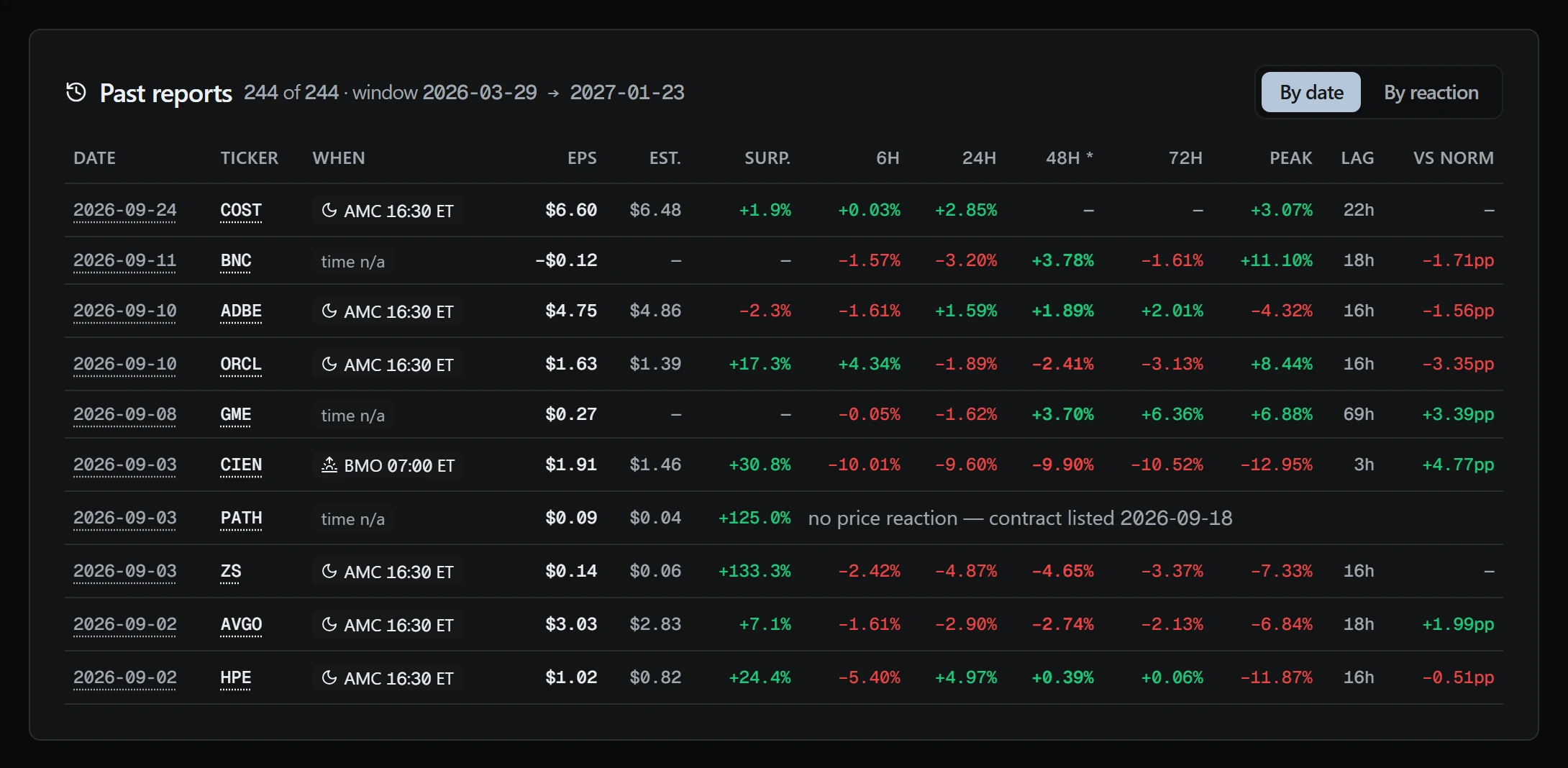
Short moves in single stocks often come on quarterly earnings days, when a company beats or misses expectations and the price reprices in one session. How prices reacted to past reports is what the Sufics earnings calendar shows.
You can buy an index through a broker and ETFs, and some crypto exchanges list perpetual contracts on stocks and indices: a tool for leveraged trades, not for long-term ownership.
Oil: why people don't hold it for years
Oil prices follow supply and demand: OPEC+ quotas, inventories (the US publishes them every Wednesday in the EIA report), the pace of the economy and geopolitics. Oil is one of the most volatile traded commodities: in 2008 Brent fell about 75% in six months, and in April 2020 the May WTI future went below zero for the first time ever because there was nowhere left to store the oil.
Holding oil for years almost never works the way the price chart suggests: funds built on oil futures lose value rolling contracts from month to month. So oil is for tactical trades over weeks and months, not a buy-and-forget asset.
Bitcoin and ether: high returns and equally deep drops
Bitcoin's supply is capped at 21 million coins, and new issuance halves roughly every four years; the latest halving was in April 2024. Since January 2024 spot bitcoin ETFs have traded in the US and brought institutional money in. Even so, bitcoin has lost more than 75% from a peak four times.
Ether is the coin of the Ethereum network, which runs apps, stablecoins and tokens. Its price depends on demand for the network, and it has historically been more volatile than bitcoin: −94% in 2018.
Whether to buy bitcoin is best decided through position size, since nobody can call the price a year ahead. If bitcoin is 10% of a portfolio and falls 77%, the portfolio loses 7.7%: painful but survivable. If it is 60%, the same scenario wipes out 46% of everything.
How do you build an investment portfolio from several assets?
Diversification works because assets fall at different times and for different reasons: gold and stocks rarely lose half their value at once. In acute crises, though, the links tighten; in 2022 bitcoin and US tech stocks fell together.
A simple sizing rule: hold as much of each asset as you can keep while its worst historical drop still leaves the whole portfolio inside your loss limit. Once a year, bring the shares back to plan. That sells what rose and buys what fell with no forecasting at all.
On your own or with a manager?
Doing it yourself is cheaper and keeps you in control, but it takes time and discipline: the classic private-investor mistake is selling at the bottom and buying at the top. With a manager a professional runs the trades, you pay a fee and take on the main risk, which is the choice of person. What to check before handing over money is covered in Managed accounts: how to check a fund manager.
How Sufics works with these assets
Sufics is a managed-capital service across these five markets: precious metals, stocks and indices, oil, bitcoin and ether. The manager places the trades, and the client sees every position in the dashboard with its entry, exit and result. The home page publishes the latest closed trades in a row, with no selection by outcome, losing trades included.
This article is not investment advice. Trading in financial markets carries the risk of losing part or all of your money, and past returns do not guarantee future ones.
Key takeaways
- Horizon, cushion and the loss you can stand in money come first; the asset comes second.
- Gold protects, stocks and indices are the core for years, oil is for trades, and bitcoin and ether are for a slice you can watch drop 75%.
- Position size matters more than the asset: 10% in bitcoin costs a portfolio 7.7% in a 77% drop, 60% costs 46%.
- Rebalance once a year: it sells what rose and buys what fell without forecasts.
- Before handing money to a manager, check the full trade history including losses, not the promises.
Frequently asked questions
Where can I invest money without losing it?
No investment beats inflation with zero risk of loss. The closest thing to not losing is insured bank deposits and short-term government bonds, and their yield is usually only slightly above inflation. Risk in market assets is reduced by horizon, diversification and position size, not by finding a safe asset.
How much money do I need to start investing?
You can buy a slice of an index fund or of bitcoin for a few dollars. What matters more is building a cushion of three to six months of expenses first and investing only money you will not need for at least three years.
Is bitcoin a good investment in 2026?
Nobody can predict the price a year ahead. The better question is what share of your portfolio you can watch fall 75–85%, which is how much bitcoin lost in 2018 and 2022. If that drop is bearable for the slice, you can hold it; if not, the slice is too big.
Can investments pay a monthly income?
Yes, but not a steady one. Dividends and coupons, the usual passive income from investing, arrive on schedule, while trading income swings: every real manager has losing months. If someone shows you the same gain every month, ask for the full trade history.
What is diversification in simple terms?
Spreading money across assets that fall at different times and for different reasons. It does not remove risk; it makes the worst case for the whole portfolio smaller.