Compound interest and reinvesting: how to calculate it honestly
Investing · · 5 min
Compound interest means earning a return not only on the principal but also on previously accumulated income. Reinvesting triggers this mechanism: every payout goes back to work. Over time the gap between simple and compound interest becomes significant, but no instrument guarantees either the rate or the reinvesting itself. All investments carry a risk of losing money.
By Viktor Skrin
What is compound interest?
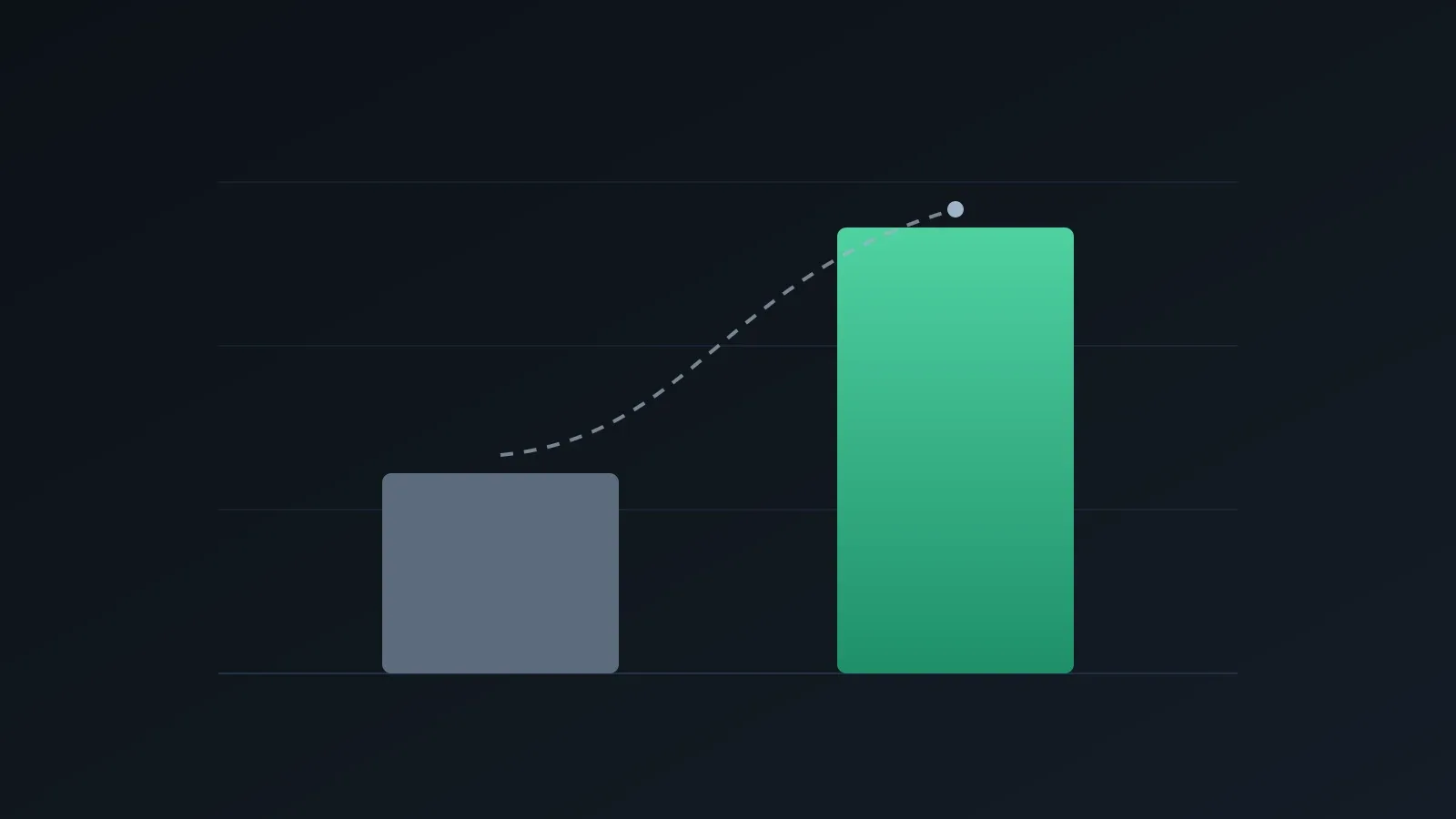
Compound interest means earning a return not only on the principal but also on previously accumulated income. With simple interest the calculation base stays fixed. With compound interest the base grows each period by the amount of the previous payout.
Formula: FV = PV × (1 + r)ⁿ
- PV — starting sum (present value)
- r — rate per period (month, quarter, year)
- n — number of periods
- FV — ending sum (future value)
A hypothetical example, not a forecast and not the result of a real account: 10,000 units invested for 10 years at 6% per year. Simple interest: after 10 years the sum is 16,000 (gain 6,000). Compound interest with annual reinvesting: ≈17,908 (gain ≈7,908). The compound gain is about 32% larger than the simple one. Over a 20-year horizon the gap widens further.
| Horizon | Simple interest (6% on 10,000) | Compound interest (hypothetical) |
|---|---|---|
| 5 years | 13,000 | ≈13,382 |
| 10 years | 16,000 | ≈17,908 |
| 20 years | 22,000 | ≈32,071 |
All figures are hypothetical; the rate is not guaranteed.
How does reinvesting trigger compound interest?
The mechanism only works if income is returned to the instrument rather than withdrawn. Reinvesting means putting a payout back:
- bond coupons go toward buying more bonds of the same or a new issue;
- dividends are used to buy additional shares;
- deposit interest remains in the deposit for the next period;
- trade profit increases the trading balance.
If the payout is withdrawn, the base for the next period does not grow and the mechanism breaks down. That is why instruments are compared with and without reinvesting: the figures can differ substantially.
How do fees and taxes affect the result?
A fee reduces the reinvesting base. This is not a one-off deduction but a persistent drag: each period the base is a little smaller, and by the end of the term the difference is noticeable.
| Scenario | Rate | Fee | Effective rate (rough) |
|---|---|---|---|
| A | 8% | 0% | 8% |
| B | 8% | 1% | ≈7% |
| C | 8% | 3% | ≈5% |
Over a 20-year horizon the difference between scenarios A and C in the final sum (hypothetically, starting from 10,000) is about 1.8 times: 46,610 versus 26,533 (calculated with the formula at 8% and 5%). This is one of the main arguments for comparing instruments by return after all costs rather than by the stated rate.
Taxes work similarly: if each reinvesting event triggers a tax payment, the base grows more slowly. The specific rules depend on the country and type of income — check with a tax adviser in your jurisdiction.
What does inflation do to compound interest?
The formula calculates nominal growth. If inflation exceeds the reinvesting rate, the purchasing power of the capital falls even as the sum in the account rises.
A simple adjustment using the Fisher equation: r_real ≈ r_nominal − inflation. With a nominal rate of 6% and inflation of 4%, the real rate is ≈2%. This matters when comparing investments over a long horizon: compare real returns, not nominal ones.
More on protecting purchasing power in the article on how to protect money from inflation.
Why is a high "monthly rate" a sign of risk?
An offer of "3% per month" sounds modest. By the compound interest formula that is 42.6% per year. "10% per month" is over 213% per year. Bonds, bank deposits and broad funds do not promise such a rate.
When an instrument promises such a return, one question is worth asking: where does the income come from? If there is no answer or the answer is vague, it is a sign of a scheme where payouts are funded by new participants' deposits, not by a real asset.
The number alone does not prove a scheme, but it is a reason to check where the income comes from. How to do that step by step is in how to check a fund manager; the drawdown that honest market participants disclose openly is covered in maximum drawdown.
How do you calculate compound interest: calculator or by hand?
The formula FV = PV × (1 + r)ⁿ can be applied manually or through a free online calculator on any financial website. The key is to set the inputs correctly:
- r — the rate per period after fees. If the instrument charges a fee, subtract it.
- n — the number of reinvesting periods, not years. Quarterly reinvesting over 5 years is n=20.
- The result is nominal. Adjust for inflation if you are comparing with other instruments.
The formula gives the mathematics of a scenario, not a forecast: the rate r is an assumption, not a fact.
Where to put money to earn compound interest depends on your goal, horizon and risk tolerance: the options are covered in where to invest money.
Investments in any instruments carry a risk of losing money, and past results do not guarantee future ones. This article describes the mechanism of compound interest and is not investment advice.
Key takeaways
- Compound interest only works if income is reinvested, not withdrawn.
- Formula: FV = PV × (1 + r)ⁿ, where r is the rate per period and n is the number of periods.
- Fees and taxes reduce the effective rate and shrink the result more than it seems.
- Inflation erodes nominal growth: the real, not the stated, return is what matters.
- A high 'monthly rate' is a sign of high risk, not of free growth.
- This article describes the mechanism and is not investment advice.
Frequently asked questions
What is the difference between simple and compound interest?
Simple interest is charged only on the principal. Compound interest is charged on the principal plus all previously accumulated income. The difference is small over a short term but significant over a long one.
How does reinvesting work?
Reinvesting means putting received income back into the same instrument. If you received dividends and bought additional shares with them, you are reinvesting. If you withdrew the income, you are not: further growth applies only to the remaining capital.
How do fees affect compound interest?
A fee reduces the amount that participates in the next period. With an annual fee of 1%, the result after 20 years is noticeably smaller than without it. This is one of the main arguments for comparing instruments by return after all costs.
Can I calculate compound interest online?
Yes, free calculators exist on financial websites. They use the standard formula. The key is to enter the real rate after fees, not the advertised one, and to remember that the rate is not guaranteed.
Why is a high monthly rate a red flag?
If an instrument promises, say, 10% per month, that corresponds to over 200% per year using the compound interest formula. Stable instruments do not usually promise such a rate. Behind such promises there can be a scheme where payouts are funded by new participants, not by real income, so the source of the income is worth checking.
Does the formula account for inflation?
The standard formula calculates nominal growth. To get the real figure, adjust the rate for inflation using the Fisher equation: r_real ≈ r_nominal − inflation. This matters when comparing investments over a long horizon.