Gold bars: how to buy them from a bank, what the spread costs and where the risks are
Investing · · 6 min
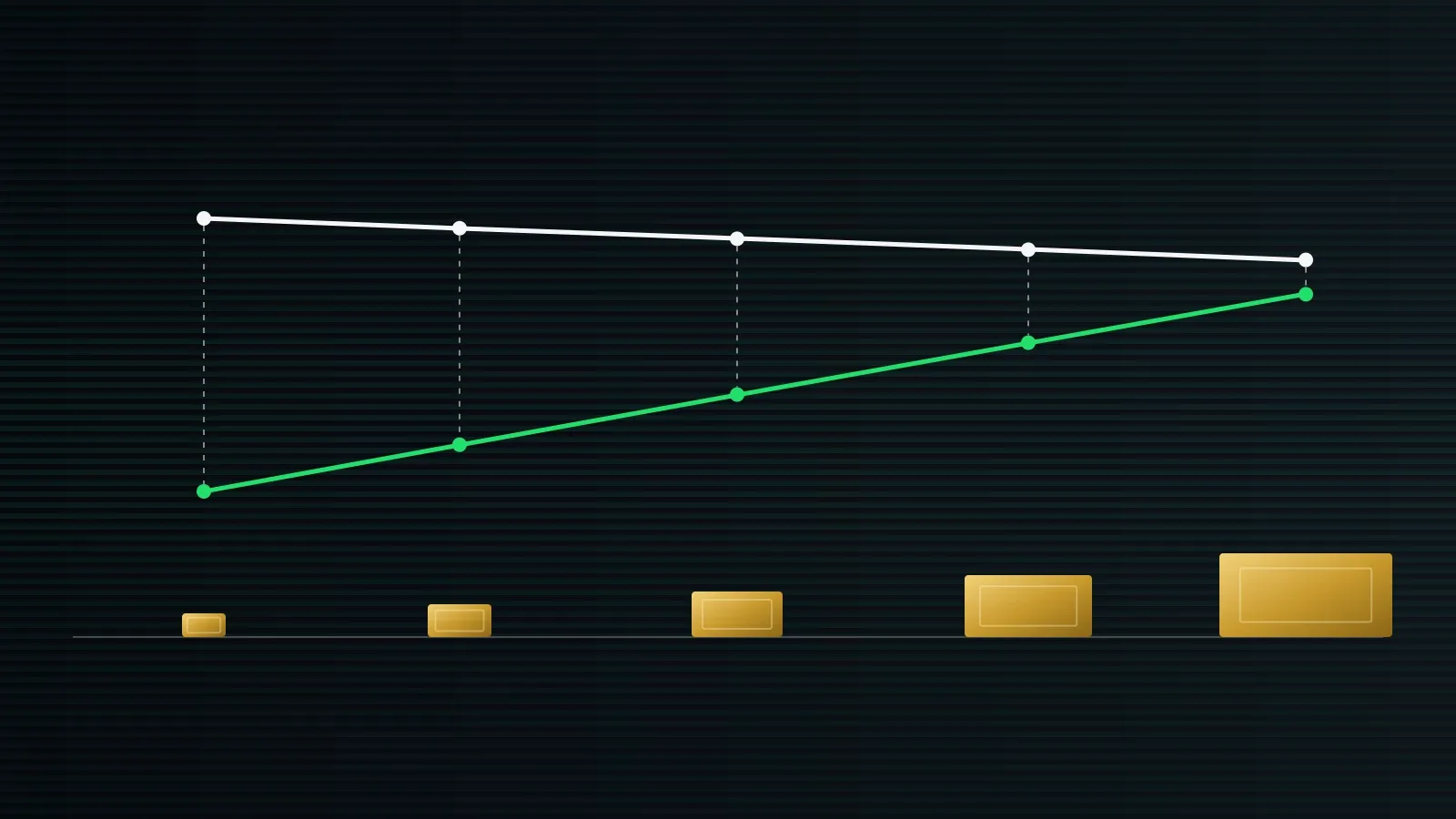
Gold bars are bought from a bank that deals in bank metals, and the main cost is the spread between the selling and buy-back price. At PrivatBank in Ukraine on 24 October 2026 it was 16% for a 1 g bar and 7–8% for bars of 5 g and more. The gold price can fall, and investing in metals carries a risk of losing money.
By Viktor Skrin
In short: what a bar costs
Buy and sell prices for gold bars at PrivatBank (Ukraine) on 24 October 2026, category 1 bars (no damage or wear, packaging intact). Source: PrivatBank's bank metals page, checked 24 October 2026. Prices are in Ukrainian hryvnia (UAH).
| Bar weight | Bank sells, UAH/g | Bank buys, UAH/g | Bar price, UAH | Buy/sell gap |
|---|---|---|---|---|
| 1 g | 7,875 | 6,615 | 7,875 | 16.0% |
| 2 g | 7,290 | 6,530 | 14,580 | 10.4% |
| 5 g | 6,705 | 6,235 | 33,525 | 7.0% |
| 10 g | 6,645 | 6,175 | 66,450 | 7.1% |
| 31.1 g (ounce) | 6,555 | 6,090 | 203,860 | 7.1% |
| 50 g | 6,500 | 6,060 | 325,000 | 6.8% |
| 100 g | 6,440 | 5,940 | 644,000 | 7.8% |
The gap is calculated from the selling price: it is the share of the bar's value you lose if you buy it and sell it back to the bank the same day with the gold price unchanged.
How do you buy a gold bar from a bank?
Gold bars are sold by banks that deal in bank metals. Each bank has its own procedure, so start with its metals page:
- Check who the bank sells metal to. PrivatBank, for example, states that since October 2025 bank metal operations are available only to its own clients.
- Choose the bar weight and compare the buy and buy-back prices on the day of the deal — rates move with the gold price.
- Find out which branches hand over bars: PrivatBank lists specific branches in several cities.
- Get the documents for the bar when you buy and keep them with the packaging: the bar's condition sets the price at which the bank will buy it back.
Banks sell bars from well-known refiners and mints; PrivatBank's page lists Swiss, German, Australian and Polish companies.
Why does a small bar cost more per gram?
Making, assaying, packaging and shipping a 1-gram bar costs almost as much as a 10- or 100-gram bar, but is spread over less metal. That is why the bank sells a gram in a 1 g bar 22% more expensively than in a 100 g bar (7,875 vs 6,440 UAH), and why the gap between the selling and buy-back price is widest for the smallest bars — 16% for 1 gram against 7–8% for bars of 5 grams and more.
For comparison, the National Bank of Ukraine's official accounting price of gold on 24 October 2026 is 182,878 UAH per troy ounce, about 5,880 UAH per gram. The bank sells a 1 g bar about 34% above that price and a 100 g bar about 9.5% above it. The NBU sets its price in advance while the bank changes rates during the day, so the comparison is approximate, but it shows the order of the costs.
How much do you lose on the spread?
The spread is the difference between the price at which the bank sells a bar and the price at which it buys it back. It is the main cost of physical gold, and you pay it at the moment of purchase.
A hypothetical example, not the result of a real account: you buy a 10 g bar for 66,450 UAH. If the gold price does not change, the bank will buy it back at 6,175 UAH per gram, or 61,750 UAH — 4,700 UAH less. Just to break even, the buy-back price has to rise by about 7.6%. For a 1 g bar it would need to rise by about 19%.
The practical conclusion: the smaller the bar and the shorter the holding period, the larger the spread's share of the result. A bar is an instrument for long-term holding, not for a one-month purchase.
What sets the buy-back price?
The bank buys bars back by category. At PrivatBank, category 1 means bars with no damage or wear and intact packaging; the bank's expert makes the final call. The table above shows category 1 prices; the bank may accept a scratched bar or one with damaged packaging at a lower price.
So it matters to:
- keep the factory packaging sealed;
- store the bar so that it does not rub against other objects;
- keep the purchase documents together with the bar.
Where do you keep a bar, and what about taxes?
There are two options: at home or in a bank safe deposit box. Home is free, but the bar can be lost to theft or fire. A box costs money at the bank's own rates, another cost to add to the spread.
Check taxes and reporting before you sell, not after: in Ukraine, the tax treatment of an individual's income from selling bars should be checked in the State Tax Service's public reference resource as of the date of the deal. We do not quote rates, because the rules change and the outcome depends on your situation.
Bar, coin, metal account or ETF?
| Option | What you hold | Main cost | Main risk |
|---|---|---|---|
| Gold bar | physical metal in hand | the bank's spread, widest for small bars | storage; buy-back price depends on condition |
| Bullion coin | physical metal, often small weights | minting premium and spread | the same, plus a higher premium per gram |
| Bank metal account | a record of grams in an account | the gap between buy and sell rates | deposits in bank metals are not covered by Ukraine's Deposit Guarantee Fund |
| Gold ETF | fund shares through a broker | fund and broker fees | needs a brokerage account; currency risk |
One detail about metal accounts: Article 26 of Ukraine's Law on the Household Deposit Guarantee System explicitly excludes deposits in bank metals from Deposit Guarantee Fund compensation (checked 24 October 2026). If the bank fails, such a deposit has no guarantee.
How gold compares with other ways to invest is covered in Where to invest money. If someone offers to "invest in gold" for you through an intermediary or a manager, check them first with our checklist.
How does this relate to Sufics?
Sufics is a managed-account service whose markets include metals; it does not sell bars. This article is about buying physical metal yourself: what it costs and where its limits are. How to judge the risk of any strategy by its worst period rather than its average return is covered in Maximum drawdown.
The gold price can fall for years, and investing in metals carries a risk of losing money: buying a bar does not guarantee it will keep its value in hryvnia or dollars. This article describes costs and is not investment advice.
Key takeaways
- A bar's main cost is the spread between the selling and buy-back price, paid at the moment of purchase.
- At PrivatBank on 24 October 2026 the spread was 16% for a 1 g bar and 7–8% for bars of 5 g and more.
- The smaller the bar, the more a gram costs: 1 g was 22% more per gram than 100 g.
- The buy-back price depends on the category: a damaged bar or opened packaging fetches less.
- Deposits in bank metals are not covered by Ukraine's Deposit Guarantee Fund (Article 26 of the law).
- Check taxes on a sale with the State Tax Service before the deal.
Frequently asked questions
How do you buy a gold bar from a bank?
Find a bank that sells gold bars, check who it sells to (PrivatBank has offered metal operations only to its own clients since October 2025), compare the selling and buy-back prices on the day and collect the bar with its documents at a branch from the bank's list.
Which is better value, a small bar or a large one?
A large bar is cheaper per gram. At PrivatBank on 24 October 2026 a gram in a 1 g bar cost 7,875 UAH and in a 100 g bar 6,440 UAH, and the spread was 16% for 1 g against 7–8% for bars of 5 g and more. A small bar costs less in total but more per gram.
How much do you lose if you sell a bar straight back?
The size of the spread. A hypothetical example, not the result of a real account: at PrivatBank's prices on 24 October 2026 a 10 g bar cost 66,450 UAH and would be bought back for 61,750 UAH, 4,700 UAH less with the gold price unchanged.
Why might the bank buy a bar back for less?
The buy-back price depends on the bar's category. Category 1 means no damage or wear and intact packaging; the bank's expert decides the category. Scratches or opened packaging can lower the price.
Does the Deposit Guarantee Fund protect a gold deposit?
No. Article 26 of Ukraine's Law on the Household Deposit Guarantee System excludes deposits in bank metals from compensation. A bar in your hands does not depend on this, but a metal account at a bank does.
Do you pay tax when you sell a bar?
In Ukraine, check the tax treatment in the State Tax Service's reference resource (zir.tax.gov.ua) as of the date of the deal and before you sell. We do not quote rates: the rules change and the outcome depends on your situation.