Stocks or bonds: how risk, return and time horizon differ
Investing · · 5 min
There is no universal winner: stocks are more often chosen for horizons of ten years or more and a tolerance for drawdowns, bonds for shorter horizons and predictable payments. A stock is a share in a company, a bond is the issuer's debt. Both carry a risk of losing money.
By Viktor Skrin
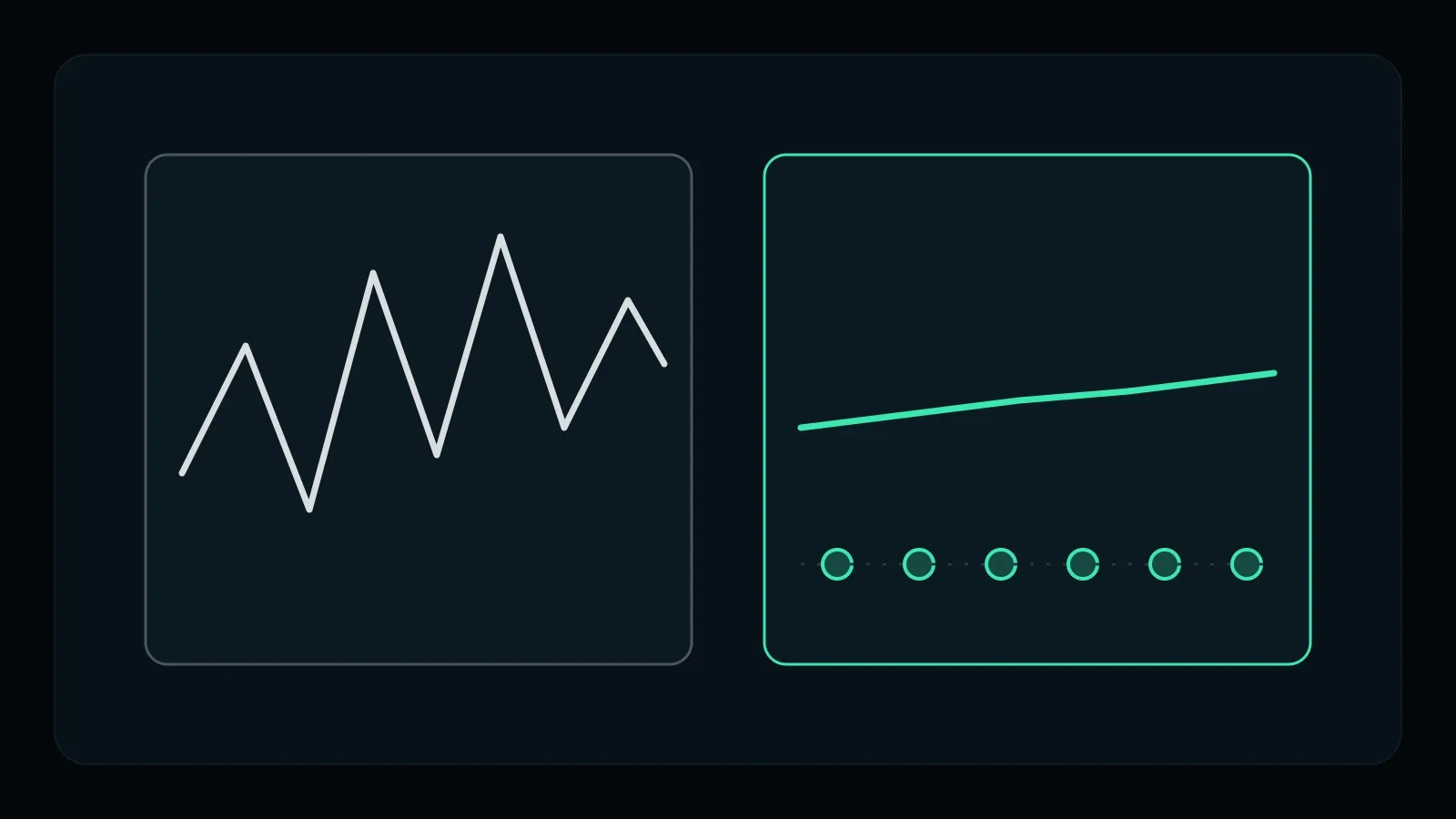
How is a stock different from a bond?
A stock is a share of ownership in a company: the shareholder gets part of the profit as dividends and a claim on what is left in liquidation, but only after all creditors. A bond is a debt: the issuer borrows from you, pays coupons and returns the face value on the maturity date. If you are still choosing where to put money, start with the overview of the options; here we compare this one pair.
| Feature | Stock | Bond |
|---|---|---|
| What it is | ownership share | debt claim |
| Source of income | price growth and dividends | coupons and return of face value |
| Place in a bankruptcy | last | ahead of shareholders |
| Price swings | large | smaller, depend on time to maturity |
| Link to interest rates | indirect | direct: rates rise, the price falls |
| Predictability of payments | dividends are not promised | the coupon is known at issue, but the issuer can fail to pay |
How does stock income work?
A shareholder's income has two parts: the price change and dividends.
Capital gain is the difference between the sale price and the purchase price. A hypothetical example, not a forecast: bought at 50, sold at 80 — a gain of 30 per share before taxes and fees. The price can just as well move the other way.
Dividends are the part of profit a company chooses to distribute. The company decides: fast-growing firms often pay none, and those that do can cut or cancel the payment.
In a bankruptcy shareholders stand last in line, so the investment is most often lost entirely.
How does bond income work?
A bondholder receives coupons and the face value.
Coupons are periodic interest payments. A hypothetical example: a bond with a face value of 1,000 and a 5% annual coupon pays 50 a year, often in two instalments. The coupon is fixed at issue.
Face value comes back on the maturity date if the issuer can pay. Buy at face value and hold to the end and you get the money back plus the coupons. Sell earlier and you get the market price, which may be lower.
The main bond-specific risk is interest-rate risk. When market rates rise, already issued bonds with a lower coupon get cheaper; when rates fall, they get more expensive.
What are the risks of stocks and bonds?
Stocks: - large price drops, sometimes lasting years; - cut or cancelled dividends; - company bankruptcy, where the shareholder is paid last.
Bonds: - issuer default: a company or a government does not pay a coupon or repay the debt; - interest-rate risk: rising rates lower the market price; - inflation: a fixed coupon loses value if prices rise faster; - early redemption: the issuer may repay early when rates have fallen.
Both instruments carry a risk of losing money, and "safe" bonds are not a guarantee: governments and corporations can also fail to pay.
What has paid more over the long run?
Over long stretches of the US market, stocks more often beat bonds than the reverse, but they paid for it with deeper and longer drawdowns. Exact figures depend on the period, the index and the currency, so the text has none: take them from the index or fund provider, with the calculation date.
Past results do not guarantee future ones. There were years when bonds stayed steadier than stocks, and years when everything fell at once: in 2022 rates and inflation rose, and both stocks and bonds got cheaper together.
When do people choose one or the other?
The choice is set by the time horizon, the goal and the ability to sit through a fall in the account. This is not advice, just the logic people usually follow.
| Condition | What people look at | Why |
|---|---|---|
| 10+ years, goal is capital growth | stocks | there is time to wait out drawdowns |
| 1–5 years, money needed for a specific goal | bonds | smaller price swings by the date of need |
| A predictable cash flow is needed | bonds | the coupon schedule is known in advance |
| No wish to pick just one | a mix | risk is split between two sources |
Many long-term portfolios hold both, in proportions that depend on goals. The popular "60/40" starting point is a reference for discussion, not a recommendation: everyone sets their own proportions, preferably with a qualified adviser.
Why do stocks and bonds sometimes fall together?
They usually behave differently: when the economy grows, stocks rise; in a downturn investors move to bonds. But the link is not constant. When rates rise because of inflation, both bonds and stocks get cheaper, as in 2022. So a "mix" lowers risk but does not remove it.
If you follow stocks, see the earnings calendar: it has the release times of US company reports and the measured price reaction. What the index most often used as a benchmark for stocks is explained in the article on the S&P 500 index.
Investments in stocks and bonds carry a risk of losing money, and past results do not guarantee future ones. This article explains the instruments and is not investment advice.
Key takeaways
- A share is an ownership stake; return is price growth and dividends; risk is total loss in bankruptcy.
- A bond is debt; return is coupons and return of par; risk is issuer default and rising rates.
- When interest rates rise, bond prices fall — and vice versa.
- Over long stretches stocks more often beat bonds, but with deeper drawdowns; the past does not guarantee the future.
- No instrument suits everyone: horizon, goal and risk tolerance determine the choice.
Frequently asked questions
How does a share differ from a bond?
A share is an ownership stake in a company. A bond is a debt instrument: the company borrows money from the holder and is obliged to return the par value and pay coupons. A shareholder is a co-owner; a bondholder is a creditor.
Which is riskier, stocks or bonds?
Stocks are generally more volatile: in a bankruptcy, shareholders are paid last. Bondholders are paid earlier, so their risk in bankruptcy is lower, but not zero.
Why does a bond's price fall when interest rates rise?
A fixed coupon on an old bond becomes less attractive when new bonds offer a higher rate. The market lowers the old bond's price to a level that equalises the yields.
Which is better for a long-term investor?
Over long stretches of the US market stocks more often beat bonds, but with deeper drawdowns. That is no guarantee: the choice depends on the goal, the horizon and the ability to sit through a temporary fall in value.
Can you invest in both stocks and bonds?
Yes, that is called diversification. Bonds in a portfolio reduce overall volatility; stocks provide growth potential. The proportion depends on your horizon and risk tolerance.